Pages

Friday, June 7, 2013


Graffiti -What is it? What is it saying?

Indigenous travelers in pre-European Hawaii walked long distances.  Shady resting locations along the routes show evidence of early day graffiti...generally human figures or geometrical patterns scratched into the weathered basalt.


Man with ore

Two figures

Australian aborigine people left their mark ...Fill your mouth with paint ...place hand on rocky wall and blow a spray of paint to leave the mark of your hand. 

Two "spray paint" hands
People wrote graffiti on  early Roman walls!  There were uncovered by archeologists at Pompeii.


Pompeii graffiti 


Pompeii graffiti
During the years of the Second World War, US troops left the message that "Kilroy Was here". That Kilroy must have travelled the world!
Kilroy was Here - little variation - same all over the world
Sociologists say that living in an anonymous world many people feel the need to make it known that they existed and that they mattered.  Graffiti says "I was here".  


Fence in Niles CA

Graffiti was revolutionized with the advent of the spray paint can... Tagging was now possible...the rapid placement of "my mark of identity" quickly and easily in many locations. Some graffiti is just in the "I was here" category - and some shows a bit of artistic expression :

Stylized lettering
Add it this the use of graffiti for gang purposes ... it became possible for gangs to mark their territories and to offer challenges to neighboring gangs. If one gang Member, in the dead of night, sprays a gang sign in the space of a Neighboring gang...the second gang must defend its honor...in whatever way necessary to reassert territorial boundaries.

Dead End Niles Gang

Sereno graffiti gang-mark

When last we visited Oaxaca I was interested to see that a the wall statement were much more representational than I have seen elsewhere.  This wasn't 30-second tags ... But sensitive faces with real Personalities.  Much of the graffiti there is intended for political statements, some describes the lives of people...

Oaxaca street graffiti

Oaxaca Street graffiti


Oaxaca Street Graffiti 
This brings to mind the issue of the line between Graffiti and murals.  There clearly is no sharp division ... But there is a whole spectrum from  garbage graffiti to  fine art.  My favorite murals are those tell the story of a people.
Oakland Ca

In the mission district of San Francisco there are marvelous murals that tell the stories of  immigrants
to America.   No place else is the story told in the same way.

Leaving home to come North.

There are WPA Murals that remind us of life during the depression...they are visual and emotional.

Unemployment during the 1930's

Towns and organizations are coming to realize the importance of stating their identify through message and history.

Alameda California


Union City CA

-----

Topic 2 : My dogs understand what matters.   

What is important is to eat everything in sight, get at least one good walk a day (preferably) in a location with other dogs to greet and sniff in social greeting, squirrels are good too.
"Its time for a walk!"
Getting fed it the highlight of the day! The Germans have a special word to describe the way dogs eat, You and I "Essen", but dogs "freshen" their food.  I suppose eating all your food as quickly as possible has great survival valve when you eating a fallen antelope with a pack of hungry friends...and our nice little house dog has just kept this pattern of behavior.  Oh and another aspect of a dog life... Sleep a lot -no point in wasting energy.  Play fighting is also good training for when called on to do the real thing.
The social world of dogs
Dogs are very sensitive to cues... when they see me put on my shoes in the morning it sometimes means that a walk is imminent.  Dogs are good observers and quickly recognize a pattern. If you repeat something three times they learn that its likely... if you repeat it every day for a week we it is law and it must happen.
    My wife Judy does volunteer home visits once a week – and in one home is a dog that waits for Judy every Friday at 10 AM.   Learn. If I’m working in my office past 7 PM, Willy comes to get me – herding me like a sheep back to the family room. John is not out front in the family room...
Play fighting - lots of sound but no fury
 While laughing about our dog’s response patterns, I noticing how often I responds to cues too. Judy and I take turns bike riding or walking with the pups – I usually go mid morning if I’m not committed, When I return the first thing I think about is grabbing a snack (hungry or not).


Graffiti on side of water district Building


Volunteers painting wall art on Water District Buildings


Friday, May 31, 2013


"Show down" in Niles Canyon

Photos this week were taken during filming of "The Canyon" ... the first "new" black and white silent movie being filmed in Niles Ca. to commemorate 100 years since the Essanay film Studio came to Niles.

****The complete film can will (hopefully) be seen June 29 at the opening night of the Broncho Billy Silent Film Festival, Niles Silent Film Museum !! 


-----

On the Eastern side of the Bay Area there lies a community with a small town feeling and access to open lands. The Niles district of Fremont sits against the base of the Southern Alameda hills, at the end of Niles Canyon to the east, Alameda Creek to the south, and Quarry Lakes to the southwest.  We have cows grazing our hills and easy access to Silicon Valley.  Wild turkeys are common in our woods and valleys but Berkeley and Palo Alto are 45 minutes away.


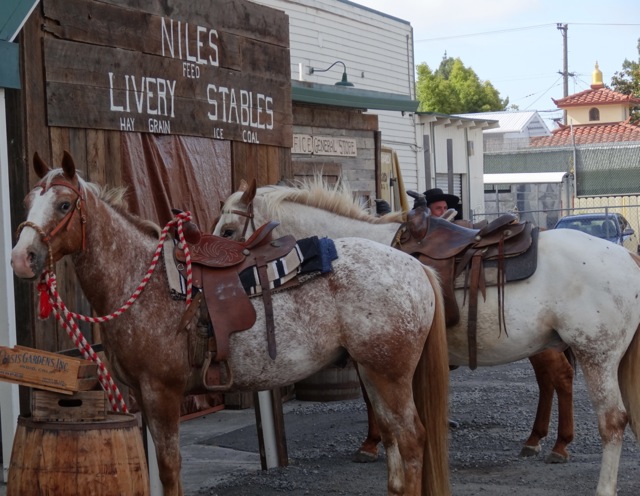
Horses patiently waiting to play their role in the movie
Some of the houses and businesses of Niles have history extending back to the time of Spanish land grants and California Missions, Gold Rush days of 1849, and the development of the first transcontinental RR. In 1956 Niles merged with 4 other small communities to form present day Fremont.  Additional  homes have been added to Niles over the years to create a kind of "layers of an onion" character - the old and the new together in close harmony.  It is a community with a strong "sense of self"  - Its a town where you can stop and chat with your neighbors.


The Photographer: Sprague Anderson ( read about him below )
Niles was the home of one of the first West Coast motion picture companies (predating the movie industry in Hollywood). The Essanay-West studio was established in Niles in 1912, and it was here where many Broncho Billy westerns were shot, along with "The Tramp" and other  Charlie Chaplin  favorites:  http://en.wikipedia.org/wiki/The_Tramp
Charlie Chaplin. http://en.wikipedia.org/wiki/Charlie_Chaplin


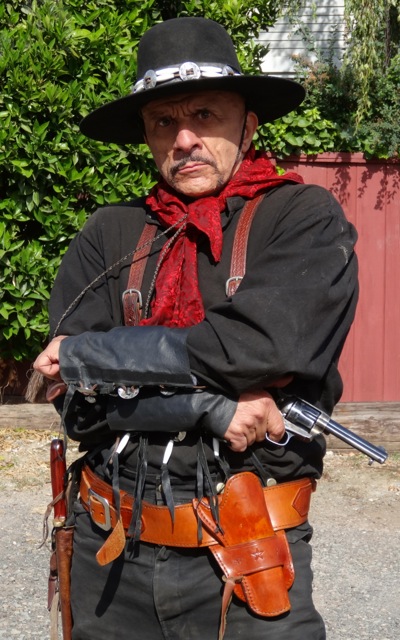
Now this is a " bad guy" for sure!

The concept of “cowboy” movies began here with Gilbert M. "Broncho Billy" Anderson who is best known as the first star of the Western film genre.  Niles Canyon and the open hills around Niles were ideal for that “wild frontier” feeling.


The sheriff taking a break - What is with the cell phone?

Today the nonprofit Niles Essanay Film Museum offers both artifacts of Niles' early “silent film era” years, and each Saturday evening, screenings of early-twentieth-century silent films with live piano music.  When I asked the piano player if the early movies came with musical scores, she told me, “No, I just look at the action on the screen and improvise...”


Actors between takes

The film museum maintains a vast collection of the early films and are engaged in collecting and preserving others. Careful research is done to establish the age of some movies.  A film showing the last images of Market Street in San Francisco prior to the 1906 Earthquake were researched and authenticated!   Plus they serve the best popcorn in town!

Highly recommended: Clip of pre 1906 San Franciso: http://www.youtube.com/watch?v=IKRbTF5afSE

The film was originally thought to have been made in 1905, but historian David Kiehn, who examined contemporary newspapers, weather reports and car license plates recorded in the film, later suggested that A Trip Down Market Street was likely filmed just a few days before the devastating earthquake on April 18, 1906.


Two bad guys - Why they might even be train robbers!
See a short video by David Kiehn, film historian, and project director as he talks about the work of the museum...  ( Read more about Mr. Kiehn below)
Upcoming movie schedule here:  http://www.nilesfilmmuseum.org/movies.htm

Full crew of actors - the dramatic "arrival scene"
During the fall of 2012 an audacious project began to take shape... Why not make a new silent film using the same techniques as those used in 1912 to commemorate the 100th anniversary of the Niles Essanay Silent Film Museum?   

The silent movie, “The Canyon”, began to emerge.  It has been a massive project – to write the script, collect the necessary talent, collect the crew and photographers who could handle the old technology, build sets, and collect money to fund the project.  The goal is to  a create a one-reel, silent western film, set in Niles  using the equipment and techniques of the silent era in a way that will be evocative, educational and, most of all, entertaining.


"Broncho Billy" greeting the heroine

While it was necessary to pay some talent, much of the work has been a labor of love, for which local talent came forward week after week.  Some had to travel long distances for each filming session.  The community was invited to participate by providing beds for visiting crew and  actors.  Judy and I have been able to host the chief photographer in our home ( for which we will get listed in the credits!)


Show down
The film is being shot on location with a steam train, horses, and ”life like” sets.  You may even have heard the exchange of gun shots coming from down town Niles.  The film  has good guys, bad guys, Broncho Billy, maidens in distress... This is good stuff! And now the finished product is practically ready!


Glamorous Movie Star Photos!


From "Indiegogo website" on the  filming of "Canyon"

http://www.indiegogo.com/projects/the-canyon

"To make the film authentic, the Silent Film Museum has recruited the resources of several local organizations. The Niles Canyon Railway will provide a steam train, rolling stock and personnel in Niles Canyon on the roadbed of the original Transcontinental Railroad amidst the scenic wonders of Alameda Creek and the surrounding hills. Other locations will include the 1901 Southern Pacific train depot, the 1911 Niles jail and historic Niles houses. Two western reenactment groups, the Congressional Gunfighters of America and the Gunfighters of the Old West, will provide actors in period costume with firearms for the movie. The Silent Film Museum will provide film equipment actually used during the silent era and still working today.

Dozens of individuals have expressed a desire to join us in working on the project. Professionals in the film community have volunteered to help. Fremont residents, relatives of original Essanay cast and crew, film students and other interested parties will also be participating. 

We will be using a 35mm Bell & Howell 2709 hand-cranked camera which is celebrating its 90th birthday this year and still works perfectly -- we've shot two other museum projects with it and used it on our April 1st Essanay commemoration event. Editing will be done at the Silent Film Museum, where equipment is already there and available to use.

Why shoot on film? Despite advances in digital media, film still sets the standard for the visual look of a production, and it's the only proven medium for long-term archival storage and retrieval. Film shot in the 1890s has lasted for more than one hundred years, and can last for many hundreds more if stored properly. What better way to honor those past achievements on film than by replicating their methods?

The film elements and finished product will become part of the Silent Film Museum collection, preserved for the future along with thousands of movies already in the archive. 

When the film is finished it will premiere at the Niles Edison Theater, a 1913 nickelodeon theater and the Silent Film Museum's home. Live piano music will accompany the film as it was originally done in the theater nearly 100 years ago. 

There will be many expenses – film stock, processing & printing, video transfers for the dvd, its completion and release, construction of an open-air film set, permits, fees and the numerous incidental costs involved with production. Thanks to the donations of time and money by those who have volunteered to help make the film, our budget is now less than what we've originally requested, but we will still need about $9,000 to produce the film. We can't change the $21,500 figure listed above, it isn't allowed, but the good news is we still get whatever you pledge  – and that’s why we’re asking for your help.

Pledge today and help us make film history, then spread the word to anyone you think might be interested. The Niles Essanay Silent Film Museum is a 501(c)3 non-profit organization. Your donation is tax deductible to the extent allowed by law. If you would like a donation receipt email historian@nilesfilmmuseum.org

Leading the project are David Kiehn and Sprague Anderson, both board members of the Niles Essanay Silent Film Museum. They produced the two 35mm silent film newsreels using Sprague’s hand-cranked camera.
And we are now happy to add Steve Kotton to our core team."

David Kiehn, director and co-writer on the project, has worked as a director, writer, editor, cinematographer and sound recordist on various projects since 1971. For twenty years he was a motion picture camera technician for several film rental houses in San Francisco. In 1995 he began research on a book about the Essanay Film Company that was published in 2003 as Broncho Billy and the Essanay Film Company. He was a founding member of the Broncho Billy Silent Film Festival when it began in 1998 and was a founding member of the Niles Essanay Silent Film Museum, a 501(c)3 non-profit corporation at its inception in 2001 after his groundbreaking research sparked renewed interest in that history. In 2010 he appeared on 60 Minutes, interviewed by Morley Safer, in a segment about his research on A Trip Down Market Street, a movie that he discovered was made by the Miles Brothers film company four days before the 1906 San Francisco Earthquake.

Sprague Anderson, camera operator and co-writer on the project, began his professional career in film in 1970, but since 1994 he’s been on the front lines of the digital revolution. When Sony introduced their first digital camera, the DVW-700WS, Sprague worked with the prototype, and he later wrote and directed the one-hour tutorial that was sent out with every camera. For six years, he did live-action compositing with the Ultimatte-8, serial number 1, and his edit suite was a test site for the early Lightworks non-linear system. For Star Wars, Episode 2, Sprague ran one of the original Sony 900 24P special effects camera systems. On Star Wars, Episode 3, Sprague worked with the new dual-link camera. In the film world, however, he’s returned to the earliest days of the medium, specializing in hand-cranked 35mm studio cameras from the 1910s and 1920s.  His involvement with the Silent Film Museum dates to 2002, filming special events with his silent-era equipment.

Steve Kotton, the Director of Photography on the project, is a four-time Emmy-award-winning cameraman with more than 30 years experience in visual communication productions. He was co-founder of Pacific Video Resources, one of the country’s most innovative video production facilities. He was the producer and cameraman on Mail Bonding, the world's first live action digital video production, shot in lush black and white and transferred to 35mm film for theatrical release. We’re eager to see his creative work on our black and white production.


For best viewing go to top left corner and click on "slide show"