Pages

Thursday, March 17, 2011


Wake Up Call

The earthquakes in Japan have been a wake up call for me and my East Bay neighbors. I often drive the length of the Hayward Earthquake fault – between Fremont and Berkeley. Along the entire route I am within a half mile of the fault. This fault had produced an earthquake on the range of more than 7 magnitude every 140 years ( last time in 1868) And according to geologic records there have been 5 major earthquake, regular as clockwork, every 140 years! Gulp... its time! Since the last large quake the East bay cities have built up with homes, schools, hospitals, the BART transit system - vitually on top of the fault. (Our home is within half a mile.) It is not a question of “if” it is a matter of “when”…and earthquake prediction is not a developed science.

Hayward Fault - the San Andrea Earthquake fault in parallel and W of San Jose

Earthquakes are due to the gradual build up of tension and distortion in the earths crust – caused by the gradual westward drifting of the North American contental mass over the Pacific sea floor crust. When the tension builds to a critical level it snaps all at once (like slowly bending a stick until it suddenly breaks). There is a continual slow creep of a few mm. a year along the surface of our fault, but deep in the earth it is locked in place.

Our California faults are of the horizontal slip variety – It is anticipated that the Hayward fault will produce a horizontal shift of 6-8 ft. BART lines and roads cross the fault in many places -imagine the disruption! Earthquake faults also are known to exist on the ocean floor – but horizontal slip faults don’t generally produce major tsumanis…

An earthquake with a 2 on the Richter scale has 10 times more movement than a one. A "3" earthquake is 10 x 10 or 100 X stronger than a 1. A "4" is 10 x 10 x 10 or a thousand times greater than a "1".

Offset in fence caused by 1906 Earthquake

Since the fault runs through heavily populated areas, more than 5 million people will be affected directly. Water may be cut off to 2.4 million people living in California's San Francisco Bay Area. The number of lives lost would depend on the time of day, the severity of the quake, and its epicenter. From what we learned in Japan imagine the benefits of having an emergency backup plan in place!

Most people choose not to buy earthquake insurance - because of the huge deductable (at least 15%), and the high cost of annual payments. Many people instead are spending money on retro- fittting their homes... making certain that the house is bolted securely to the foundation, adding additional internal or roof supports if needed. If a house is burned as a result of the earthquake, it would be covered with fire insurance.

Earthquake safe construction - Note amount of internal steel and triangulation

Best preparation: Know what to expect, and plan ahead!

1. Many communities have trained community response volunteers ready to assist in search and rescue, fire control, medical aid when needed. My community has a CERT program in place. They welcome new volunteers who seek training:

http://www.citizencorps.gov/cert/start-3-1g.shtm

2. FEMA has an excellent web site on what to do before, during and after an earthquake – good reference:

http://www.fema.gov/hazard/earthquake/

3. Learn about the potential for shaking in your area based on your subsoil type: ( you must use the controls to find your street and home location)

http://gis.abag.ca.gov/website/liquefactionsusceptibility/
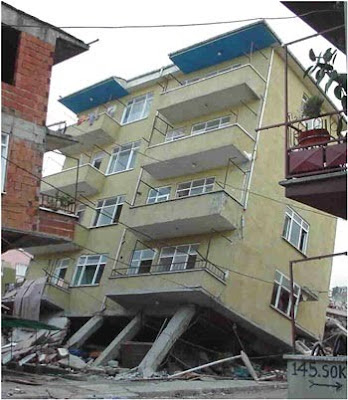

Unsafe!: "Soft first story" is a building with parking or shops below apartments

4. Prepare two emergency response kits - one for your home and family, the other for your car in case you are far from home when it strikes. If I am in Berkeley at the time of a major earthquake I would need good walking shoes, small bills for buying necessities, and portable food for my long walk home! http://www.ehow.com/how_4536778_make-earthquake-kit-car.html

5. I keep a bookmark on my computer on this site from the Geological Survey - it shows instant results immediately after each earthquake to show how strong it was and where it was located - also interesting to see how many small quakes we have each day.

http://earthquake.usgs.gov/earthquakes/recenteqsus/Maps/special/California_Nevada.php


Thursday, March 10, 2011

Notes: 3/12

A. Finished are the dark rainy days of winter, bare tree branches, cold gray clouds… Spring is the return of color and light… the return of new growth and daily surprises. I walked with the dogs this morning in warm sunlight with no jacket! Look! My fig tree had buds this morning!

Growth bud on fig tree

B. I have been growing lettuce, green onions, Italian parsley, radishes, and cooking greens in my vertical garden. We have had a regular supply of salad greens all winter because I selected varieties that would withstand frost and low temperatures. Now in mid March it is sad to report that several plants – lettuce, kale, radishes, parsley are all beginning to bolt.

Lettuce bolting - see elongated stem

Plant cells have genes that allow the production of plant hormones that stimulate rapid elongation of the stem. The “trigger” that turns on the genes that allow the hormone to be produced is the length of night darkness. In winter the long nights prevent the hormone and the lettuce grows normally. But once the night length drops in length with the coming of spring, the genes are activated, the hormones released, and the energy of the plant goes into producing a tall stem, and flower and seed production.

Collard greens - bolting - Note elongated stems and flowering

So – I went to my favorite nursery and asked what varieties of lettuce I could grow during the summer without danger of summer bolting. I came home with Forellenschluss, Manoa, and Black Simpson as good candidates.

I use an aluminum turkey baster pan with holes punched in the bottom, filled with potting soil, and plant the seeds. I cover the germinating seeds with saran wrap, and set it in a sunny window After 4 days they looked like this. Once the plants get big enough I will transplant them into the vertical garden.

Seed bed - starting lettuce plants to be transplanted into vertical garden

Now I remove all the bolting plants from my vertical garden –

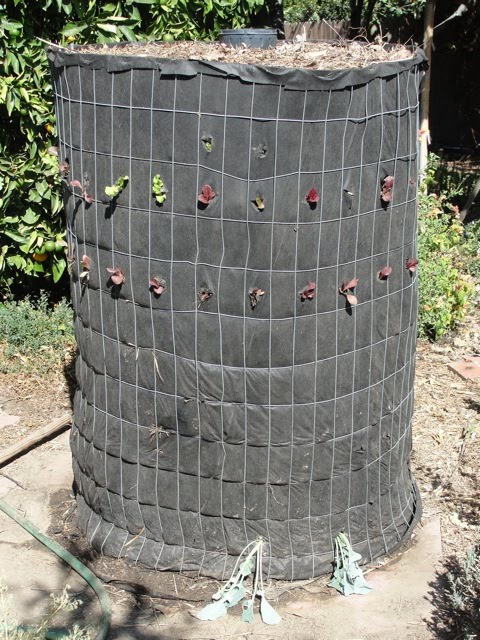
How to make a vertical garden

1. Go to your hardware store and get enough 5-6 ft (width ) strong wire fence (holes 3-4 inches square) enough to make a cylinder with a diameter of about 40 inches.

Just after completion and the first seedlings have been planted

2. Line the inside of the cylinder with weed guard – or other fabric that will not break down.

3. Place the cylinder where you will get the best sunlight possible.

4. Hold a 4-5 inch plastic pipe vertically in the center of the cylinder while you alternate small layers of top soil, green compost, seasoned compost, manure, sand, if needed to lighten the soil… layer by layer until full to the top edge of the cylinder. Then I add a few garden worms to provide aeration.

Close up detail of first plantings

5. Fill the central pipe with 1-2” gravel … and remove the plastic pipe… This is the watering core … you can add water here and it will travel around the gravel and water the entire cylinder evenly. – Water the system well. In the heat of the summer – one watering will generally last for 4-5 days.

6. Allow to settle for a few days… add more soil/compose/manure if needed to bring it to the top again.

7. Now you are ready to make holes in the fabric on the side of the cylinder and insert small plants through the hole into the soil.

8. You can use small plants that you buy in the nursery or you can easily start them yourself – as I am doing with my aluminum pan.

9. The cylinder does include microclimates – so plant things that do best with full sun on the sun side, and broad leaf green leafy vegetables can generally take a lot more shade and thrive.

10. It took me about 2 hours to set up my complete vertical garden – and I planted it slowly as I had time or as plants became available.

11. This garden can be grown without chemicals - even snails are much less a problem here than in a conventional garden - If I see a snail I just pick it off... Every few weeks I add a bit more steer manure to the top to add nitrogen... In the summer it will need water in the central gravel hole once every 4-5 days depending on the temperature.

Vertical garden in early February

----- ----- -----

TWO FAVORITE Links:

1. The University of California has created a site called "Life on Earth"... take some time to wander around and see what it there... its amazing:

http://www.ucmp.berkeley.edu/alllife/threedomains.html

2. Flexbook is a kind of high quality teacher cooperative - providing a range of materials to support teaching high school math and science courses - for example - click on the Biology text - then open a chapter on Cells - note that it has short video clips, sample student labs and response papers... This is an on going work that accepts high quality materials from volunteers to grow the program

http://www.ck12.org/flexbook/


Thursday, March 3, 2011

Notes 3/4/11

1. Spring!

Wild field mustard
The fields of mustard are in full bloom
Red bud bushes are glorious in their color
The tree swallows have returned in number
Mocking birds are tuning up!

2. Wisconsin

Here’s to the courageous people of Wisconsin who continue to stand for their hard won collective bargaining rights! The first line of our constitution speaks of “union” – and it is within our national character for groups of people to come together to work for the common good.
A Modesto farmer placed this sign beside his property

Isolated workers will accept low paying jobs when they are desperate - but they will not build a strong country. A country with low paying jobs does not have a strong middle class. When the people are well paid for their work they spend more and the entire economy is healthier.. When workers are forced to accept low paying jobs the economy stays depressed. In recent decades we have seen a decline in the expectation that each new generation will automatically thrive economically.

Public employees and workers in Wisconsin and across the nation are not asking for irresponsible wages – only for the right to continue collective bargaining – to negotiate with their bosses as a group what their wages and working conditions will be.

Teachers protesting reduction in funding for school programs

Teachers in America spend a minimum of 5 years becoming trained for their profession, and continue taking courses and attending workshops for their entire career.. Prior to collective bargaining teachers lived on the margin of the economy – with no hope of participating fully in the middle class. I have been a member of the California Teachers Association for over 35 years. Year after year we have negotiated collectively for a reasonable salary, for secure health and retirement, and for teaching conditions that would benefit the students and community. If that had not been available to me, I would now be struggling to provide for the financial security and health care of my wife and I, or more likely I would have left the profession. The issue is about the willingness of a community to support quality education.

Sign in Portland Oregon - found on walk through a river docking area

Between 2001 and 2009 the US has lost a vast number of factories. Most of these companies have not gone out of business - they are now outsourcing 32% of all manufacturing jobs in America that existed in 2000. Who is to blame? Large companies wanting to maximize profits go to where labor is cheap? Does that mean that American workers should accept third world salaries and living conditions to keep companies here? No! It is an example of the fact that we now live in a global economy - old solutions will no longer work. We must change our approach! Here are two examples of changes that we must make to stay competetive: 1. We must develop and produce products that the rest of the world wants. America must constantly innovate to stay competitive in this world economy. 2. We must train workers for competitive participation in the new economy. The key is to make quality, affordable, relevant education available for all. Those without education will become the new poor.

The way our national financial crisis makes me feel - Sign in Pescadero California

An effective solution to the current financial problems in state and local governments is to raise additional tax revenue. Since early human societies reasonable taxation has been recognized as the necessary way to finance the common good. We need to maintain and expand our national infrastructure, we must be willing to support public employees if we seek to retain a quality work force, we must recognize that a quality way of life must be funded collectively. I don’t like to pay taxes – but I like even less to see my country decay for lack of adequate funding. I advocate a higher tax rate for those making the highest incomes. In the past 30 years, the average after-tax income for the top income 1% of Americans increased by 176%, while the poorest increasingly struggle to make ends meet. Powerful lobbies in Washington are looking our for the rich and powerful - but who is looking out for the poorest and neediest in our society?

See what average American's say about how they suggest balancing the budget:http://voices.washingtonpost.com/ezra-klein/2011/03/how_americans_want_--_and_dont.html

We hear so much about the national debt -and the effect of taxation . For a good summary go to WikIpedia http://en.wikipedia.org/wiki/National_debt_by_U.S._presidential_terms

Wall Poster - JLKing Middle School - Berkeley Ca

America must stop thinking of ourselves as a country in isolation – We cannot go back to some imagined form of government developed in 1776. We are now in serious competition in a global economy, in global politics. Living in a taxophobic country has caused our way of life to slowly decay. The countries with which we are competing are spending tax money on developing infrastructure, maintaining a quality education system, providing health security for all people... and we are talking of cutting taxes - which will lead to even less support for those programs that we need to stay competitive as a nation.

Sign I found hiking along the Rogue River - Grants Pass Oregon

Well funded financial interests and political groups in America today are seeking to engineer public opinion. These are the so called "news services" that provide little factual news and emphasize their particular bias and opinion. The play upon the fears and prejudices of the American population to achieve their ends. Those who listen to such opinion programing are led to confuse what they are hearing with factual information. Of course this is why the financial interest and political groups spend last amounts of resources to create such a system. As I said last week, it can be hard to learn the truth. On my computer, I have bookmarks on 5 very different news sources. Daily I compare the headlines on each and read a bit of key stories. The difference in content and emphasis is amazing!


Saturday, February 19, 2011


Notes: 2/25/11

1. Kadafi has declared war on his own people. He said "I made this country and I can destroy it." Many in his own army have deserted him and he now hires foreign mercenaries to take their place. Western nations seem unsure what action to take. But still the people go out in the street in the tens of thousands to say "We have had enough with this dictator. We want democracy".

In the American revolution the slogan was – “Government of the people, by the people, and for the people…” For democracy to work there must be a fair and open exchange of ideas.

What makes the United States (and the rest of the world) uncomfortable with the changes in North Africa and the Middle East is that we can not control or predict what these newly freed Arab democracies will become.

A Mosque and garden in Turkey

It appears likely that within a year we may have a broad restructuring of North African and Middle Eastern politics. The democracies that emerge will most probably be based on multiple parties (like the Italian or French systems) with all voices contending to be heard. Like Turkey, I hope that both secular and islamist parties will be included. When parties are suppressed it is than that they become dangerous. If the people throw off this long standing dictator it is their time to experience the power of their own government - not the time for us to impose our will on them.

Inside of a Mosque - Istanbul

This quote comes to mind: “ One mans terrorist is another man’s freedom fighter” - Certainly true of Moshe Dayan and the British, True of Charles DeGalle and the Vichy French in the Second World War, true of the American Patriots in our Revolutionary War, Yasser Arafat and Israel… Kadafi is feeling very uncomfortable right now with the people in the street – he calls them cockroaches and terrorists, instruments of the US and Osama Ben Laden…but to the people on the street he it the one with a long history of the most brutal terrorism.

As I write this blog the outcome is undecided - Kadafi has a history of surviving tough situations, he is brutal... but the people are a force he has not faced before...

-----

Temperature: 53F in February, 60F in August

2. Moist Pacific air flows past the beaches, over the hills and mountains of the California Coast, the towns, farms, and cottages of farmworkers. It flows past oak savannas, grass lands with grazing cattle, the fields of cotton and corn, through the Sierra forests and rocky crags beyond. California life depends on the moisture carried by ocean air...


The Alaska current carries water south ward along out coast

In the winter, the middle latitudes over Northern California are a meeting place for confrontation between warm moist tropical air and cold arctic air masses. The warm air is forced to rise and moisture is released as rain in the low lands and snow in the mountains. Winds out of the northwest, off the cold Pacific Ocean, carry storms to us – sometimes one after another in January – April.

Vast amounts of water and lifted from the sea and return as rain and show

We don’t have "spring" in the sense that the midwest and the east coast have. New growth begins with the first fall rains. Light winter frost slows but doesn't stop the growth, there is a slow progression of life as long as their is moisture– New sprouts, new growth, a sequence of flowers… but no sudden dramatic change from winter to spring. As long as we have water we have growth.


Much of the San Francisco area receives about 15 inches of rain on average each year

Spring weather can be 70 degrees in February and a week later 35 degrees.. It all depends on whether our air mass has come to us from tropical or arctic regions. By the third week of February daffodils have just completing their brilliant yellow blooms, I see serious green buds and growth on many plants, lifeless looking twigs are suddenly sprouting green.

The first fruit trees are blooming - almonds and plums now apricots, peaches, and apples later. Our future plum crop is in jeopardy right now – we have had days of steady rain recently and it is not good weather for bees to be about. Frost is the kiss of death for fruit crops in bloom…we keep our fingers crossed.

Plum blossoms have the smell of spring that bees can not resist. The slightest breeze carries a snow storm of petals...(they eddy and swirl in the street below). When the petals are gone, the task is just beginning - each flower ovule now has been fertilized and can form a sweet summer fruit.


Monday, February 14, 2011

2/18/11
People photo #1

Jumping to conclusions

In this blog I have added ten photos of people that we have met in our travels. Just for fun test yourself to get in touch with your first impressions as you see each picture, (then check at the bottom of the blog to learn more about these 10 individuals or groups). Are you drawn to some?, do you fear some? Why? What assumptions would you make about each person if you met them on the street- How would it affect how you approached them? The photos do not relate to the message of this blog...if they overlap its only by accident.

People photo #2

I hate it when someone, without knowing me, puts me in a pigeon hole and treats me as if they have already decided about me. They may decide that they like me or don't like me, that I am their kind of person or not... That I have the "right" social beliefs or not) , they may speak up to me, down to me, condescendingly to me. That makes me outraged!

People photo #3
If I am honest I have to admit that I am sometimes guilty of the same crime when I see someone of a different social, political, or age group... and I quickly make up my mind without really taking time to encounter this person. I fear that I sometimes jump to conclusions.

People photo #4

In Mexico we came across a man while hiking in the mountains. He looked like he might be a forestry worker and I put him in that pigeon hole. As we talked I found that he had a PhD in plant pathology and had a special interest in virus infestations in forest trees. I learned so much talking to him about the natural history of southern Mexico. I had made assumptions about this man that were completely wrong.

People photo #5

When I first started working in the inner city schools of Oakland I encountered students whose appearance made me think that they might be potentially dangerous gang members. But as I got to know these kids as individuals I found them eager to learn biology so that they could continue their education. I saw kids that looked like rough street kids performing well in academic classes - They were using biological vocabulary and asking intelligent questions. Perhaps they dressed this way to not stand out in their community. My first impressions were not correct.

People photo #6

Sometimes when I walk the dogs I meet a man who had a stroke… he walks with a severe limp, his speech is difficult to understand, and his face is not quite straight. I think a lot of us treat people with handicaps like they are not like the rest of us. Imagine my surprise when I learned that he and his wife had been noted singers and had published a number of CDs of their music, he had also been a championship runner when he was younger. When I patiently listened to what he had to say I found a sensitive intelligent person with a longing for real human contact.


People photo #7

Sometimes I walk the dogs through a park where a number of homeless men gather in the morning to eat breakfast together at a picnic table. On occasion I have stopped to chat with them. They had funny stories to tell and we laughed together – They were not down on drugs or drunk… they had just lost their jobs and lost their homes and were wondering how to get their lives back on track. My wariness of homeless people is not always right.

People photo #8

I admit it - My guard goes up when I discover someone is politically conservative. I expect them to attack my beliefs so I prepare myself for their anticipated onslaught. I dredge up all my expectations for what I assume will be their political beliefs and of course then it becomes difficult to have a relaxed open discussion. What a shame – I am probably shutting out good people. I have a sneaking suspision that I may have much in common with some of these folks if only we could talk beyond our differences. We have a humanity beyond our different beliefs.

People photo #9

People photo #10
-----

That's News to Me

When something happens in the world how do we find out about it? How do we decide how we think about the event?

Southern Mexico - Street baracade with police on the other side

The Cairo phenomenon has brought this home to me- If I checked five different news sources during last week, I would find five different interpretations of the reality that was happening in Egypt

But the news industry is what turns “reality events” into our attitudes and beliefs. They make choices about which facts are published and which are held back. TV stations and newspapers are in the business of making profits. Profits are based on pleasing adversisers and attracting a large number of viewers/readers. Some news sources are strongly connected with special interest groups and political parties anxious to advance their agenda. Seems like most news sources have an ax to grind.

A serious journalist is akin to a detective – it takes hard work to develop an accurate story, – The journalist must check sources – go into dangerous situations, take risks for his or her career … When journalism is done right it helps the people - the nation - to sort out truth from fiction. Sadly year by year less journalism is done this way... Now its ...check the wire service and write the story... More and more news sources simply borrow an article from another news service.

Southern Mexico - Bus burning - Street demonstrations

Is the news we choose to watch dominated by fact or by opinion? Opinion pieces can influence entire nations of people. Any propogandist knows this – If you want to alter public opinion it isn’t about fact - its about planting seeds of fear and doubt that matter. It is a healthy habit to ask “ What is actual evidence for saying this”? Wild ideas produce crazy actions and wild results. Think of the source that told us that Iraq had weapons of mass destruction and mobile chemical labs. This last week it came out that that man, now living in Germany, told the press that he only said these things because he didnt like Saddam Hussain...he had no evidence...

Photos are evidence – we trust what we see… but different news sources can put a different spin on the same photos – One person’s freedom fighters are another persons dangerous radicals. One persons rightous defense of the constitution may be interpreted as a danger to human freedom by others.

Contrary to popular opinion reporters do not have a special connection with “truth”. All they have to work with is the information that comes over the wire services or what they can observe and confirm first hand. Being in the midst of a confusing situation does not give automatic insight into the situation - Truth is hard to tease out...

Lesson 1: Check your sources, Lesson 2: Is the evidence sound? Lesson 3: Don't get trapped by your political preconceptions.


People photos

1. Czech students on a summer camping holiday ( waiting for a train)

2. Community Organizer - Havana, Cuba

3. Russian living in Kyrgystan with his bird hunting rifle

4. Greek village couple

5. Uzbec man who drove us in his car - buying gasoline

6. Care giver - Tanzanian orphanage

7. Tour organizer - Arusha, Tanzania

8. Collective farm workers - Cuba

9. Driver and Guide: South Africa

10. Homeless man sleeping on the street in San Francisco