Pages

Friday, March 30, 2012


Notes: 3/30/12

1. My lone back yard frog has now attracted several others to his choir. Every night, starting at twilight, they “sing” well into the night. This pattern raises questions for me. What – oh what – are these cloaks and chirrups communicating to other frogs? My guess is that they are saying – “We want some girl frogs to come join us here!” And maybe they are saying – “This is a good deep pond ideal for raising a family of tadpoles.” Since the females do not give a responding call, so I cant know if they have been successful in their attraction.

Pacific Tree Frog ( like mine )

Frogs are very much a bellwether to the health of environments. World wide there has been a dramatic decline in the numbers of frogs within the last few decades… For some species this may be related to climate changes. More likely it is due to the increased concentrations of chemicals in the waters where most frogs are found. Studies show that an accumulation of scrap plastic in the water releases a chemical that mimics the natural reproductive hormones found in frogs – thus altering their normal reproductive cycle. Given the decline I have all the more reason to be joyful for this happy chorus in my back yard.

Pacific Tree Frog

Imagine that fertilized egg (when it is produced) carries within it an incredible sequence of information of how to become a tadpole, enzymes for digesting algae, forming legs, developing into an adult frog, and then totally changing the digestive system and enzymes to be able to digest insects (no more algae as an adult)… This wonderful collection of DNA comes with natural genes that turn on and turn off the production of hormones, enzymes, and structural proteins needed for each stage of life in sequence.

Capital Building - Washington DC

2. Once again we get an insight into how Washington is influenced by big money. One man, one vote democracy as we have known it is under the spell of super PACs that do not have to identify donors, and can contribute unlimited amounts to the candidate of their choice.


Hallway in Senate Office Building - each door leads to a Senator suite

What is wrong with American voters that we are so susceptible to the powerful media campaigns to create our "opinions"? It is called “ social engineering”... skillful advertising folk who join forces with politicians to design “hit pieces” directed at a target audience – And who is this target audience? It is you and me being confronted over and over again with not only blatant advertisements, but planned appearances on shows, interviews by the candidates.

Social engineering link: http://en.wikipedia.org/wiki/Social_engineering_(political_science)

Supreme CourtBuilding

Look at your self and your attitudes and opinions about each candidate. You don’t know these people, you probably have not done an in depth study of their legislative records... How then have we come to a conclusion about how we feel about each candidate? In this age, even the news we choose to listen to built around a predetermined bias – do you choose to be indoctrinated by Fox news or by MSNBC news? Have you noticed that the candidates repeat the same message lines and key words over and over again?
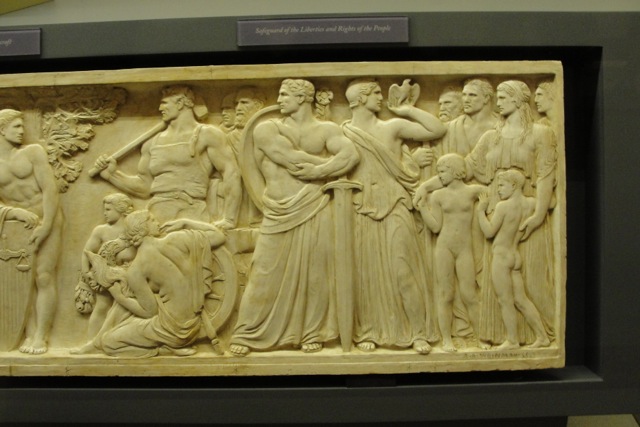
Frieze on wall of Supreme Court Bldg - signifies equal justice for all in America

Those phrases have been carefully designed to drill and kill the image, the ideas, that they want to place in our heads. I despair for the American voting public at times – Romney is saying over and over that Obama has made the economy worse, that unemployment is languishing, that Obama is responsible for increased the national debt – any examination of the actual data shows that all three claims are utterly false… Many people simply choose to believe the ideas that support their positions – the facts interfere with reality and are not being considered. One politician that I admire said that voters tend to elect the candidates that they deserve. Is that scary of what!

Fairness and Certainty of Justice

Friday, March 23, 2012


Notes: March 23, 2012

Note: today's photos were copied from the halls and classrooms in Oakland Ca schools.

1. My pond has been found worthy – for the first time in the many years since I started the pond – frogs have gathered to sing their hearts out every night! This might not be music to everyone’s ears… but I love frog sounds! They are small Pacific Tree Frogs… but my goodness…do they have loud voices. They start at twilight each night and sing until long into the night…. I am curious to notice is their sound patterns are temperature related or if they are controlled by factors…They do stop their sounds if there is any sound or a yard light turned on... I wish them well...

Not sure if this for the benefit of the students or the teachers...

2. Also this week the first tree swallows returned (We will get cliff swallows later in the year aas well.) The first tree swallows are scouts – if it is too cold they will return to the south until warmer and then return – after one morning viewing them they were gone again.


Faculty lounge

3. What a strange year – still very dry - But there has been enough rain to allow many normal signs of spring – the blooming fruit trees, first green leaves, the progression of spring flowers… all earlier than normal this year. There are clumps of California poppies and deep blue lupines – but the grass and wild herbaceous plants are greatly reduced without normal rain. While the rest of the country has been sweltering in a March heat wave, we have had a real cold snap.

Classroom Hall

4. I urge you to take the time to listen to this rebroadcast of the Forum broadcast from KQED The Dropout Crisis: Solutions “ This is one not to miss!

http://www.kqed.org/a/forum/R201203221000

Inner city student hallway

The program deals with the education realities of inner city schools. This program is of great interest to me because it describes the lives of the students and teachers in the schools where I’m supporting interns. The general population so easily blames poor people for being poor, not speaking English, being uneducated, …

Mills College exit gate

Many in the general population blame the schools – blame the students… blame the parents… but never offering positive solutions to the problems – because most people don’t understand the issues of daily life in the inner city. Most people have no idea what the vast budget cuts have done to the education system in California.

Inner city classroom wall

In fact the realities run deeply and intertwine with the lives of middle America too… Please take the time to listen to these interviews and learn more about what our American kids face, and what hard working teachers are attempting to do… What I heard here closely matches my daily observations as I visit these schools.

Inner city student's statement about High School
(Copied below)

5. "Well, high school is like a mountain for us students. We have a long way to go until we get to the top… There are times when most of our classes are getting harder and we feel like giving up…My advice for some people who are giving up is don’t stress yourself, believe in your talents, and have faith.

For me, life and making dream come true is like if you have land, and you have to work on it so you can harvest, but through all of that process you have to take care of it; that’s how life is.

I would like to graduate from high school and get a better life for my family because I want my mom to be proud of me and let her know that I didn’t waste her time. I would like people to graduate and be somebody in the future, to change the world with better people."

7th grade classroom wall

Friday, March 16, 2012


Notes March 16

I was 15 years old when I got my first real summer job. My neighbor, living across the street, worked each day at his father’s large orange farm, and each day I rode out with him to do whatever they needed help with that day. The farm soil was good – but about 2 feet down was an impenetrable layer of “hard pan “soil that had to be broken up with a special John Deer Caterpillar tractor pulling a deep digging tool – It was my job to follow along, on foot, with a sledge hammer to break up the clumps of hardpan soil.

Sign along side a country road in the San Joaquin Valley

Other times I joined a team cutting pieces of wild African orange twigs, which were then rooted in a mist chamber, and then Navel orange stock was grafted onto this superior root system. In addition I used a hoe to cut weeds, I cut their lawn once a week, and I sometimes worked in the young orange tree nursery thinning the buds that were forming on the new young trees. Valley summer weather is often over 100F and the air very dry...

The "farm" where I worked was near the Sierra foothills

The farmer routinely went to Mexico to buy and smuggle pre-Columbian art pieces back into the US…

At the end of the season I was rewarded with the extra bonus of visiting their high mountain cabin in the Sierras… this entire family was one of the most exotic I had ever encountered at that point in my life!


Me spraying a dairy drain - this was weed control so that the 'poison' could hit the water

At the age of 16 I went to work, each summer for 4 years, with the Mosquito Control agency. I started as a “sprayer” - my field operator had a region for which he was responsible – he kept track of when farmers irrigated, and then checked their fields for mosquito larvae. When he found them I went to work! I would fill my 4 gallon spray can with a mixture of Parathion spray, pump up a good head of pressure, then walk up and down the fields or pastures covering each bit with my spray. At times the soil underfoot was deep with gooey mud, and at times the sky was a-swarm with biting mosquitos. The job paid well, for a student summer job, and I enjoyed the people that I met.

My driver was a grizzled old "oaky" WWII vet– he had been in the Pacific Islands – and he had such stories to tell! He also loved old style country music and I learned a lot about different singers.

We were spraying in the Central Valley of California – we had in our zone 3 villages make up largely of seasonal fruit pickets – there were the descendants of the people described in John Steinbeck’s ‘Grapes of Wrath’ – living now in mostly tar paper shacks with tin roofs. They were poor, had no skills, often health problems, and social problems. As you zip down Hwy. 99 you will not see them – but a few miles off the road they exist to this day – with a lot of anguish and no safety net.

A country grocery store in Traver California - I bought moon pies, and coke!

Each day we sat under a scruffy “China Berry Tree” beside a little country grocery store to eat lunch – over the time I was there I got to know several of the locals and hear their stories. One old “gentleman” was a “wino” ( he got the most alcohol for his money by drinking ‘Thunderbird’), a thief, and he tried to bed every woman in town…and was frequently in the county jail for one offense or another. Still he was a jolly guy and often came to talk to us as we ate lunch. (Also we often shared our lunches with him too…) He often had little items that he had stolen that he tried to sell to us...scissors, a comb, a wrench, a sprinkler... he needed money for his next bottle of 'thunderbird'.


Country Blacksmith shop - Did hot metal repair and replacement of broken farm equipment

In my daily work, there were times I had to wade into chest deep water covered with duckweed, and walk down the middle of still water sloughs to spray… I always watched for snakes!

In my last two years I was a Dairy Drain Operator – I was given my own little green jeep – and a 100-mile day route of dairies to travel and spray drains. This put me in touch with Portuguese, Mexican, and old established Anglo farmers… I remember well the rich and varied sounds and smells of the dairy milking barns. I think it was then that I discovered that every person has a story to tell.

Valley vineyard - November

Mosquito abatement work was often exhausting but I learned to see the beauty in the arid flat planes of Central California. I must have open and shut 10000 bailing wire fence gate latches in my coming and going!

After I went away to college I had other summer jobs – but none of them as “educational” as my first jobs. I was a delivery person for a large travel agency in San Francisco and walked throughout the financial district, travelled up and down elevators, in and out of offices… hand delivering new travel tickets to customers. Office secretaries were generally polite but impersonal.


San Francisco looking west from Coit tower

For a short time, one summer, I got a job with a furnace cleaner – my employer was something of a charlatan with a fancy impressive looking suction system mounted on a truck – we made a hole in the side of the heating systems and sucked air for a while – but I don’t think it really did much good… I quit after a week…

I was a guard in the college library, checking each persons bags to make sure they were not stealing books… that was kind of fun…

San Joaquin Valley country road

Teaching is an all-consuming task that I have never worked summers in addition to teaching. Many years I took summer classes or received small grants from the National Science Foundation to take part in special training sessions.

When I reflect on my early forms of "education"... I may have gotten my knowledge in college – but I learned about life, work, and to appreciate a range of people from some of my varied early summer experiences.

Saturday, March 10, 2012


Notes: Week of March 9

We humans tend to make patterns where there are none - this is a normal quartz intrusion

Photos this week are a collection representing the artistry to be found in rocks...Each rock has a story to tell, as well as beauty in itself. These rock were once sedimentary sand and gravel, then compressed and heated deep in the earth. The Sierra Mts. are mostly composed of granite, but this is typical of the older cap rock found above the granite... these are all metamorphic rocks from over 10000 ft. in Tuolumne.

Quartz veins injected into fractured granite rock

Under great pressure, the rock mass was super heated so that liquified quartz could be injected into rock cracks. The metamorphic rock was heated to a softened condition but keeping some of its original sedimentary character… At some later time conditions changed and it was able to cool.

A metamorphosed sedimentarty rock heated and contorted to produce folds

Later the rocks were raised over long periods of time by the shifting earth crust to elevate it to its present height… then erosion by water and ice have exposed it… Last, the surfaces were cut and polished by the action of glaciers into the surfaces we today…

Iron compounds leached out of parent rock and deposited on metamorphic rock

TAKING A CHANCE...

I am a gambler this time of year – We may still have cold nights with light frost – but maybe not… So I think its time to plant tomatoes!

Metamorphosed sedimentary rock, cut and smoothed by glacier action - note striations

I know the common wisdom to wit until late April or early May – but we have a south-facing wall with great heat even now – and my early tomatoes take off.

Metamorphosed sedimentary rock with quartz intrusions, then folded to form striations

Starting tomatoes is all about preparing the soil! I dig a hole for each plant at more than a foot deep and a foot wide and refill with a rich blend of organic material mixed with soil. I use compost, horse manure but you can add any good organic material.

Quartz intrusions through granitic rock, then iron compounds added

Small plants are available in the nursery now – For several years I have grown Ace and Early Girl varieties… Here in the bay area we just don’t have the heat for a good crop of most of the “heirloom varieties –

Granite was fractured, then large heated quartz intrusions added

I have tried them and while I get a few tomatoes – its just not a good crop. I can count on lots of tomatoes over the entire season. Ace tomatoes are about tennis ball size and Early Girls are a bit smaller.

Rhyolitic flow: Obsidian with a lot of ash suspended in the liquid rock, cooled at surface

I plant the small plants deep so that at least two inches of the stem above the original soil line is covered with my soil. As you plant them, create a watering ring around each one. Then soak well.

Higher quality obsidian

With my dogs I also surround each plant with 4 vertical sticks to prevent them “accidentally” lying on top of them.

The bottom end of a small glacier - Ice causes much faster shaping of rock than flowing water

And don’t forget to treat each plant with snail pellets!

Now should it be that a frost wipes them out – I’ll just do it again!

Sedimentary metamorphic rock turned 90 degrees and then cut and by glacieral action