Pages

Friday, March 4, 2016

Fire Air Earth and Water


There comes a day each spring  when I suddenly see that everything is sprouting new growth.  The 'red bud' tree is awash with color, even the Yellow oxalis look beautiful with intense yellow.  (I do my best to overlook how invasive they are...) New growth is sprouting out of 'dead' branches. It is a riot of activity!  It is good!  I walk with the dogs and everywhere - the world appears as it should be on such a morning...
Fig tree bud

 I say “I don’t see any great changes taking place..." "Melting polar ice caps don’t affect me" " the air pollution in China isn’t my problem" " So what if the average annual temperature is .5 degrees warmer this year than last and the sea level has risen a fraction of an inch?  These changes may well accumulate  to affect future generations of people and even mass extinctions of some organisms, but not me on a morning like this!   It requires effort on a day like this to deal with real problems.

Plum blossoms
But I know -   There have been natural changes in  the past - but never such a rapid change related to human activity. We have only one earth - and every day there are more us of living on it...What can I do today to be a little more responsible...?  Like your mama used to say to you - "its time to clean up your room!" Isn't it ironic that the 4 elements of our universe recognized by the ancient Greeks, (and independently by other cultures) have come back to prominence for us again? 

Bad air day in Bejing
Many organisms on our earth are adapted to live in very narrow environmental limits - adding chemicals or changing temperatures even a slight amount  have already been fatal to thousands of species - "once something becomes extinct it will not return to our earth".

To the ancients it made logical sense that all forms of solid matter were aspects of 'earth' - the rocks and minerals, the flesh of animals and plants, metals and pottery...
German  Air - Fire - Earth - Water 
Air was what we breath, what surrounds us, what a bird flies through.  Air was not visible but essential for life...It would be long years before such fine distinctions as Oxygen, Nitrogen, and Carbon dioxide were known.
Natural 'fire' from the Earth
Fire was seen as a strange 'substance' to the ancients - it was something powerful that could be locked within some forms of matter (wood. coal), it was the energy of the sun, even the earth generated it in volcanoes...  Fire (heat) tended to rise and dissipate into the air...
Imaginary periodic chart
Water was different from 'earth' in that it was fluid - Oceans were a mystery - Was the earth afloat on a 'great sea' ?- Did the earth have known limits and then endless water? Was there a great sea over our heads that sometimes gave us rain?  Moisture could rise in the air to form clouds and then fall as rain... Water is capable of evaporation and freezing ... pretty mysterious!
Air - water 

Now the interesting thing is that these elements could often combine into single phenomena...  Humans had components of solid earth, we breathed 'air' in and out of our bodies, there were aspects of 'fire' within the human body - hence our body heat.  Fish however did not have this fire in their bodies.  And water was an important component of our make up.

To us today this all seems naive - yet to Aristotle, early Arabs, Chinese, and Indian cultures this was the product of good inductive reasoning... In the the origin of our primordial 'science'.


Water
Why is it important today - because we have gotten ourselves in a fix over these same 4 elements?  We have created systems out of balance with the natural world.  Please visit this site - highly recommended! https://royalsociety.org/~/media/Royal_Society_Content/policy/projects/climate-evidence-causes/climate-change-evidence-causes.pdf

Long ago, deposits of fossilized organisms trapped sunlight energy stored inside them- they would represent solid "earth" to the ancients but they contain the capacity to release fire - energy to make our gasoline or coal to burn for industry.   They also release vast amounts of carbon dioxide into the air and this has resulted in a mechanism that traps energy in our atmosphere and even heats the ocean.
  
The great surging sea - constantly exchanging materials and heat with the atmosphere
In addition, we have through our industrial manipulations created an array of liquid and solid products that have found their way into the ocean - causing changes in the chemistry of the sea... Atmospheric CO2 has dissolved into seawater to create changes in sea water acidity... plastics are extremely slow to break down and they tend to concentrate in the sea interfering with the feeding of natural organisms.  Even the air we breath has become contaminated with exhaust from our cars and industry causing a serious increase in asthma and respiratory and blood diseases that shorten life.  Products of the plastics can mimic naturally occurring hormones and alter the development and life cycles of organisms, also stimulate abnormal cancers.
If we deny these facts we are 'ostriches" burying out collective heads in the sand...

Our one and only Earth 

Why are we reluctant as a society to correct these problems?   Thats simple - we are entrenched in a way or life and an economic system that would find the corrections painful - coal and oil producing states would stand to lose jobs, taxes, and a way of life.  We like the convenience of jumping in our cars and 'going places' (I do!) ...But every time I go to the store to buy milk or bread I am adding to the climates greenhouse gases...  ( Its just easier to pretend that these problems dont matter! ) We need new technologies to eliminate the need for fossil fuels... its starting - if you have solar panels on your house- hurray!  If you drive an electric car...super!  These technologies will continue to grow and expand.  Imagine what eliminating our dependence on foreign oil would do to the world economy and politics.. There would be winners and losers.
What can I do and you do to minimize my damage to the environment?  The Sierra club has the motto "When you go into wilderness - leave nothing but footprints"


Sea Anenomies are very sensitive to changes in seawater pH

We are so in love with our current system of conveniences it is a challenge - I want to go to Europe?  No problem hop on a commercial plane (jet exhaust), I love my plastic everything - it doesn’t last very long - but thats OK -when I'm done with it I throw it away (There is no 'away' in this world).  I get hungry for fresh tomatoes in January - ah the supermarket has them - They must travel by diesel truck from Mexico - but I'll overlook that) When I want to throw something away I now have to make a decision is it compost, trash, it recyclable...Is it too much trouble to make that distinction. 

But on a day like this please cut me some slack - I will enjoy the glory of springtime and watch the buds swell and sprout new life.


Friday, February 26, 2016

Green jeeps and mosquitos

All this business with the Zika virus reminds me of the summer jobs I had starting with the summer after my sophomore year  until I completed the local community college. I worked for the Delta Mosquito Abatement, located in the north end of Visalia California in the Central Valley. At the operation center there was a metal Quonset Hut for the "bosses", a parking area for a fleet of old Korean war surplus jeeps (each outfitted with a 200-gallon tank filled with Parathion insect spray), and a garage overseen by a tough old guy names "Buster" - he took great care of the jeeps, and all the equipment - and tried his best to put the fear into us to not do anything stupid that would harm 'his' equipment. 
My Jeep was never so clean - At times I would return to my Jeep and find cows gathered around sticking their heads inside...
A 4 gallon Hudson sprayer - these babies were heavy then carried through thick mud on a hot day!
Each summer morning at 7 AM the drivers and helpers gathered out in the open air near the gas pump for the daily briefing - and special information that was pertinent to us all - any new mosquito information, any 'civilian' complaints, anything 'to do' or 'not to do'.The field operators could also put in orders for certain large fields to be sprayed from the air. We had an old slow stable Stierman biwing with a very 'colorful' pilot - who loved what he did...


San Joaquin  - with irrigation it is green and wonderful - no water - it turns dry and dusty
When I began, I was a "helper", and  every morning I climbed into the Jeep with Matt D. (the field operator in charge of the area we worked) ... an interesting guy... Native to Oklahoma, his family came west with the dust bowl, he was drafted into the Army - went to fight in the Pacific islands.   He still bore the emotional scars from the experience. He was a wealth of amazing stories about his life and adventures.  He loved old time country music. Little Jimmy Dickens, Earl Tubbs, Hank Williams...And from him I learned to "talk Oakie".
The Jeep had no doors or walls and in the early summer air it was  really cold- We drove north to Goshen Junction and then east toward the area of New London California - the land was flat and only produced  crops because  of irrigation water. And that was the problem - there were constantly large areas of land with standing water.  


Dipper method - looking for larva
Matt had to keep meticulous data of each of the many fields for which he was responsible.  We would at times take water dippers and collect a sample of water to look for larva.  Alfalfa and pasture lands most often had a species called: 'Aedes nigromaculis'. This one is a serious pest and can be very prolific.  We also looked in standing tubs, flower pots, horse tanks for 'Culex tarsalis' - this one is capable of carrying encephalitis.  One that we dreaded to find were the "Anopheles" mosquitos capable of spreading malaria.

Note abdomen filled with blood
When we identified an alfalfa field with active larva - we got out of our jeep - filled 4-gallon pressure cans with Parathion spray, pumped them up by hand,  then I slung the can onto my back with the strap crossing my chest and off we went.  The two of us would walk the  field swinging out wands back and forth releasing spray.  Sometimes we would start on opposite sides and work to the middle.  Many fields were deep with sticky mud.  
The only photo I could find - and old WW II photo - but we did it the same way ( except this tank has a different pressurizing system)
 There were often clouds of mosquitos to content with. A big field might take much of a morning or afternoon.  Sometimes when Matt had extra work I would drop me alone to spray a field alone.  In those cases, he sat up a 50-gallon tank on sawhorses so that I could refill my can.  When lunch time came around we often drove in to Traver California - there was a grocery store, a China Berry tree and a tiny patch of lawn where we ate lunch. 

When we were in the neighborhood at break time we would go to a truck stop for coffee and a donut
My favorite General store in  Traver California - good place to by Moon pies and Coke
All the little towns in this area were inhabited by seasonal field workers.  The towns would generally be considered as centers of rural poverty. The homes are made of simple materials, often no paint, have weed filled yards, skinny barking dogs. But the people that we met often had fascinating life stories to tell.  One particular wino often came to eat with us (he mostly was happy to share our lunches).  Sometimes he had items that he had stolen that he tried to sell to us...But he was a jolly man with stories about jail, his lost loves, some big 'deal' coming up...
 
The style of homes in New London and Traver... I hope that  conditions there have improved
Make of the people in these towns were descendants of those who escaped the dust bowl in the midwest
Finally, the day came that I got my own little green jeep - I was promoted to spraying dairy drains!  The work was much easier but I missed the camaraderie of working with Matt.  Milking requires a lot of water-  and vast amounts of water collect and breed mosquitos.  Many dairies had made long trench drainage areas -about 12 ft., wide and the length depended on the size of the dairy, the trench was dug to be about 12 feet deep.  Some just let the water go where it will. On a typical day I drove about 100 miles - Going from one dairy to the next.  
The life cycle was dependent on the day and night temperatures
Many of them I could spray without leaving the jeep - I just drove slowly by the pit or pond of drainage area and sprayed my poison onto the surface.  Some were not jeep accessible and then I was to walk into the farm or along one of the the sloughs.  I learned to deal with savage farm dogs!  My favorite slough was one that was about chest deep and there were thick blackberry vines on each side - so I had to walk down the middle of the slough, spraying as I went,  through slimy mud and floating duckweed... but I loved the biology of this place.  I needed two full days to complete all of the dairy drains on my route.  Many of the dairies were owned by Portuguese dairymen - who frequently went out of their way to offer me fruit from their trees. Thats where I learned to love fresh ripe figs!
Delta Mosquito abatement also had a person who went around putting mosquito fish into home ponds, horse tanks, or other  permanent water
A memorable day I recall was the day that 2 of us were sent out to deal with a mosquito source- it happened to be by a watermelon field.  The owner was still there and we asked if we could pick over the left over melons (and there were a lot of them) - he said "Sure - take all you want - I'm going to plow this up” So we loaded the jeep with watermelons - full and over full with watermelons.  Wouldn’t you know it - some well intentioned citizen phoned in to the office and said that 2 "mosquito boys" had stolen a bunch of melons.  Fortunately, it was Buster who took the call - and when we drove in the gate - there was Buster in his best Staff Sergeant pose asking us to explain ourselves - we did - gave a nice melon to Buster and it all ended well.
That's me - here I am spraying herbicide around d a dairy drain so that the poison can reach the water - this is a special jeep just for that...


When I think about those years - I remember barb wire fences,fields full of cows ( and occasionally bulls), vast dust devils swirling on a hot summer day, heat and dust, mud, deep mud, and hoards of mosquitos... but I remember faces and voices - so many good people...

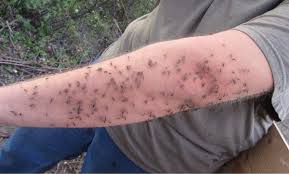
What my arm looked like on many occasions - It was often so hot that I didn't want long sleeves unless I needed them.