Pages

Wednesday, April 13, 2011


The Zlatniks come to America

My grandparents, Antonine and Julie Zlatnik, were married in Libštát Bohemia during a restless time. Many farm families in the region were immigrating to the United States with the promise of a new life and affordable productive land.

Family home in Bohemia

The Austro Hungarian Empire was alarmed that so many farmers were leaving for America, and so large tracts of land were opened in the eastern regions for homesteaders. Antonine and Julie went east to the Volyn Valley of what was then Eastern Poland, but today is NW Ukraine. The local government encouraged different national enclaves to exist there – and the Zlatniks settled in with other Bohemians, including a number of Julie’s family.

My grandmother's extended family in Boratin (Volyn)

Antonine and Julie, still drawn by the American promise, were dissatisfied with the low yield that they were able to harvest from the land due to the climate of the Volyn region. And while they could “get by”; they decided that it would be wise to take the risk and go to America. They sold everything, land, tools, and animals; travelled by train to Hamburg Germany and embarked for the new world. They crossed the Atlantic, passed the Statue of Liberty in NY harbor,

Smithsonian Museum - Washington - Artists view of arriving immigrants

... entered through Ellis Island, and discovered their first shock – the rate of exchange for their money was far lower than they expected – so they entered the US with a limited amount of money. They had been in touch with other Bohemians who had found good land in the Midwest – and so first they visited a number of locations before they finally learned through “through the system” that there was good land in NE Kansas and there they travelled. A supportive Moravian, George Heijtmanek sold them a block of farmland, but that required practically the last of their money.


Early home English lesson - in the hand of Julie Zlatnik

So as others had done before them, they set about building a creek bank dug out – first they dug back into the soil to build a living space, lined the dugout walls with logs, added crossbeams and thatch, created a system for rain runoff, and made a simple door for the front. Windows were made of greased paper to allow light but exclude rain. A stovepipe extended through the thatch to carry away smoke from the cooking fire. The land was rich, growing corn and wheat. They added cows and pigs to sell for profit. But for the first years they were desperately poor. They often lived on corn meal and game that they could hunt.

Grandfather Antonine (?) with pig in the early years - this pig is ready for market!

Education was important and the children went to the village school – but at first they had difficulty because they spoke no English – some of the other Bohemian and Moravian students helped them to learn. They went to school without shoes, but feet wrapped in canvas wrap.

Delia Presbyterian Church (English language) replaced the Moravian church (Czech)

The Zlatniks were devout Reformed Moravian church members ... a Czech language church, and quite similar to the beliefs of Presbyterians. Their local area had a community Moravian church that was both the spiritual center and community center for the new immigrants – both Bohemians and Moravians.

Bohemian/Moravian community in the early years -

To greatly add to family difficulty, tragedy struck. Antonine died of water borne disease in the early years. My grandmother Julie and her family of 5 boys and 2 girls continued farming the land and survived with the help and advice of the Czech church community.

The first wooden house -

In a few years they were able to build a simple wood frame house. Progress was slow but living conditions steadily improved.

Inside of the first wooden house

My father Anton was not able to attend high school because of family responsibilities, but was self educated – always reading. When we applied for the position of local mail carrier he had the highest score on general knowledge and was awarded the position. With income both from that job and the farm, the family moved to a larger farm with a small wooden house and a twofloor rammed earth house. They weathered the depression largely living on the produce of their own farm, but selling enough to stay afloat financially.

As the Zlatnik sons and daughters grew older they spread out – one to Nebraska, one to Idaho, and one eventually to Southern California, and two remained in Kansas. Neither of my aunts married – one died while she was in training to work with the immigrant community in Pittsburg, the other continued to live on the family farm with grandmother Julie. From this family have now grown an extensive number of Zlatniks scattered across America!

Grandmother Julie in later years with my sister Helen

By the time I came along my farther and mother had a farm of good rich soil creek-bottom land near to the town of Delia, and also near to the old family home. My father continued as the local mail carrier, which was no small task in NE Kansas where the mud roads turned to chocolate pudding in the spring and the snow drifted high in the winter. I feel great admiration for my family and for the many adversities that they faced to establish a good life in America. I’m sure Antonine and Julie would be quite amazed to see the luxury that we live in today two generations later…

Thursday, April 7, 2011


Notes 4/8/10

1. As our country is facing a possible shut down of government - these are the points I would like to tell my representatives-

a. When the American people are permitted to prosper the economy will benefit. Programs that benefit "business" at the expense of "people" lead to the impoverishment of our population, and the diminishment of their buying power. Don't cut social programs and use the money to give tax cuts and benefits to the rich. The bottom 50 percent of income earners in the United States now collectively own less than 1 percent of the nation’s wealth. The rich are getting richer and the poor are getting more poor!

A city of American people

b. If money for scientific research is cut (as it is proposed), it will damage an entire generation of scientists and scientific work. It might lead to a balanced budget but at what catastrophic cost to the US world scientific standing and competitiveness?

c. Making education accessible is a priority - if we are to compete in the world wide economy we much have the best trained innovative workers. We can not compete with low cost manual work in third world countries - if we are to survive it has to be in the area of developing and producing new high tech products. This requires trained people. This week it was stated the tuition to the UC universities will double if funding is not made available.

A neighborhood of wage earners - the American Middle Class

d. Trickle down economics has failed. The rich can spend only so much for their own needs. Excess money received by the wealthy tends to be invested in risky financial endeavors that can lead to further financial instability through the economy. The 400 richest people in the United States now control more money than 155 million people at the other end of the socio-economic spectrum combined. Despite the financial crisis, the number of millionaires in the United States rose 16 percent to 7.8 million in 2009 ( last data available).

The increase in American population is evident in our changed traffic patterns
e. With the increased American population we have more workers, with increased technology we have more automation, companies have moved offshore to maximize their profits. New jobs (not service jobs) are going to require new research and development - we must develop new products that we can produce better and cheaper than anyone else - and this all requires well educated innovative people.

f. Politicians, as you settle the budget forget the "riders" ( tacked on unrelated items that have been added to the bill in the hope of getting them passed too). Don't be distracted by side issues - don't get waylaid by petty partisan bickering - you have a nation to run!


2. With my concern for the state of the nation I still have a great love for the constant surprises I find in the natural world. I walk my two dogs most days ( 3.5 miles = 1.3 hours) Grasses have grown tall with this winter's rain and the thistles and mallows are splendid in this season.


Wild mustard still in bloom

This past week I found a mature 5" grasshopper - how it survived the winter I don't know - also monarch butterflies, and comical black beetles that are out seeking a mate his time of year . They routinely stop and hoist their rear end to release a scent ( a pheromone ) to attract a girlfriend. Mockingbirds are now in full song... Killdeer have returned. I suspect that our rain is pretty much finished for the year - But for now it is the peak of the growing season.

3. I continue to work as a student teacher field supervisor. I travel at far north as ElCerrito, South to Hayward, West Oakland, and East Oakland... I admire the courage of my young teachers - attempting new things for the first time is always a challenge - and the good student teachers are constantly testing themselves with attempting new ways to make their teaching most effective for all students.

Campus of Mills College - I attend weekly seminars in another building

The best teachers are not afraid to take risks... sometimes they experience great satisfaction when something "works" well - but its OK when it doesn't - A good "flop" is something to learn from. I see my student teachers for two semesters and we are now in the final quarter...I have seen them evolve from timidity at the start of the year to confident tweaking their performance now.

Student teacher at work

I see them now with clear learning objectives as they start a unit, individualization of instruction for special needs kids, and developing means to get a meaningful response from all students in the class. Some are now starting to put out feelers for job hunting ( most school districts don't know their needs yet for next year).

One of the inner city neighborhoods where one of my schools is located

4. Judy and I have no wild daring plans for summer adventures this year- No return to Chiapas or Tanzania... Unless some chance opportunity comes our way we will probabily travel close to home - An extended trip to our dear Tuolumne Meadows ( with with 160% snow pack this year it will be late July or August before we can get in)

Tuolumne meadows - this photo is about 10,000 feet

...probabily a trip up the coast to Oregon and maybe into Washington... the coast is beautiful in the summer and we have a string of friends and family to visit. There is even much in the Bay Area that we dont seem to have time to do during the year - I love walking through some of the neighborhoods in San Francisco ( Urban Hiking!) and the museums... Our closest ocean coast land is about an hour from us - and it is fine too... We still enjoy tent camping - so who knows where we'll end up...

Science Museum - San Francisco

San Francisco has some excellent museums - the new Natural Science museum in Golden Gate Park, the Asian Art museum, three really good art museums, then a variety of small museums on the grounds of the old Presidio military base.

"The Thinker "-(Rodin)- Stanford art museum
5. Several years ago public television had a long term series of adaptations of the Poldark saga... A story of life in Cornwall just prior and during the Napoleonic Wars. Judy and I enjoyed them greatly at the time We are now reading them - and finding them much more detailed than the film version - but I warn you they are addicting - and page turners. You can find good used copies on Amazon.com


Thursday, March 31, 2011

Notes – Week of 4/1

A. The seasons are far enough apart that each time of year feels fresh and new. – Each season in turn feels like it is my favorite. Each day, as I walk, I discover surprises. Tree branches that were bare last time I walked this way now have great bursting buds. Poppies are blooming orange along the trail.


The wind - the water - cows on the hills

I feel sorry for people that walk around with earphones in their ears. Imagine not hearing the mocking bird, the distant scrub jay, the crunch of gravel under foot, the wind blowing in my ears… (Click here to hear a mocking bird: http://www.birdjam.com/birdsong.php?id=4)


Hill top near our home- the only sound here is wind in the grass, and chirping insects

Hearing a familiar sound is like finding an old friend – my friend the song sparrow, the distant train whistle, the distant bark of playful dogs, Canada geese arguing… – Subtle sounds that I have to listen for...

B. Something I learned this week from a Kindergarten teacher: "We all carry an invisible bucket that contains our feelings. When our bucket is full, we feel great. When our bucket is empty, we feel sad. A "bucket filler" is someone who says or does nice things for other people. By doing this, they are filling other people's buckets and filling their own bucket at the same time.

Whose bucket is getting filled here?

On the other hand, a "bucket dipper" says or does things to cause other people to feel bad. A "bucket dipper" empties their bucket when they say and do mean things, they feel worse too.

This is a concept taught to 4-5 year olds - seems good for the rest of us!

C. The results of the National 2010 census are in! Our city, Fremont, now officially has 38.5% white, 46.8% Asian, 14.6 % Latino, 3.3% African American, Pacific Island .7%, Native American .7%. While this is true - many are from 1st or 2nd generation families and are just as American as I am.

Judy and I are cultural chameleon… We happily slurp noodles in a Vietnamese pho shop, eat with our hands in an Ethiopian place, know how to order a meal in an Indian restaurant, and know what level of hotness to order in a Thai cafe. We know the best Russian pastries and when to go for Dim Sum.

Wall mural

We visit events on Dia del muertos, Martin Luther King day, the India festival, the Moon Cake festival, Dragon Boat races, Dia del Virgin de Guadalupe, Native American Powwows, Thai New Year, events and concerts in the Bay Area Euporean communities: German, Italian, Greek, Russian...

Tablisi Russian ( Georgian ) Bakery

Our favorite restaurant is a neighborhood Taqueria called “Los Dos Gallos” (The two roosters). Another excellent place is an Afghan restaurant “The Salang Pass” … Everett and Jones does the most amazing southern Bar B Que. The Blue Nile gives us spicy savory Ethiopian food. We love to explore the amazing variety of Asian flavors and textures found in the foods from China, Japan, Vietnam, Thailand, India, Pakistan, Korea. and Indonesia...

Chinese Temple in China town - SF

This also really isn’t so strange because over the years of living here our neighbors, students, and friends have invited us and shared with us their traditions. We find richness in the human fabric of this place. The various ethnic groups of the San Francisco Bay Area pretty much live as neighbors and friends with a minimum of negative interaction.

Student invitation to participate in Dia del Muertos

By and large we go beyond "tolerance" to "acceptance" and "friendship".. It is my hope that as the world continues to shrink, as internationalism grows world wide, we can do so in this manner. Nothing is lost by being open to the customs of others...

D. As the spirit of spring returns to the land – a gardeners thoughts turn to tomatoes! For me the process begins with choosing the best location. Every home has many microclimates – I choose two small garden patches adjacent to a south-facing wall (they receive several hours of sunlight each day).

Next comes soil preparation. Dig in lots of good organic material – either compost or soil conditioner – I like for each plant to have prepared soil at least 14 inches deep and 18 inches wide. A garden fork with long tines is an ideal tool for mixing the soil. If you have heavy clay soil –adding organic material is especially important.

Ace Tomatoes

Talk to old-timer gardeners in your neighborhood to learn about the best tomato varieties for your local. Now I make a trek to my favorite nursery. My choices are “Ace” tomatoes – they are resistant to almost all common diseases, have great flavor, and produce from July until November… They are the size of tennis balls. (I prefer tomatoes that are not too large.) I also plant Early Girl tomatoes – because they are early – but they also produce well – they are also a smaller tomato… Forget the “Beefsteak” tomatoes – you get a smaller crop and frankly their flavor isn’t as good as “Ace”.

Plant the small plants deep so that you cover at least half of the stem – All of the buried parts will add to the root mass of the young plants. Plan ahead and shape a good water basin around each plant at the time of planting. Water each young plant and wait for them to grow! Through June make sure that the plants stay moist – developing tomatoes should never go dry. In July and August cut off the water – and only water once or twice when the soil is very dry during the fruit bearing season.

Starting this early the poor little plants will probabily sit shivering their little roots when the weather turns cool again - but we are having quite a spell of warm weather right now - enough to get them well established.

E. One of my favorite photographers, Henri Cartier Bresson, said this about photography- “ For me the camera is a sketchbook, an instrument of intuition and spontaneity, the master of the instant which in visual terms, questions and decides simultaneously.

A captured moment -photo by Henri Cartier Bresson

In order to give a meaning to the world, one must feel involved in what one singles out through the viewfinder. The attitude requires concentration, sensitivity, a discipline of the mind, and a sense of geometry

A captured moment ii -photo by Henri Cartier Bresson

It is through economy of means and above all by forgetting oneself that one arrives at simplicity of expression.

To photograph is to hold one’s breath, when all facilities converge to capture fleeting reality. It is at that precise moment that mastering an image becomes a great physical and intellectual joy

For me, photography is to place head, heart, eye along the same line of sight. It is a way of life. “

Monday, March 21, 2011


Notes: 3/25/11

1. Adventures come in all sizes: The pups and I decided to take our chances this morning. Spotlights of sun were shining through the clouds highlighting the lakes and hills with areas of brilliant color…in contrast, dark clouds hung in the sky to the south and west.
Threatening morning!

Yesterday a gale was in full blow out of the south - intense winds - Waves! – A regular surf rose along the shore line … I was warm and dry inside my jacket – and the water sound in my ears and the drizzle in my face made for a fine walk…

Sunlit foreground

But today there was calm– as we set out, we encountered, flying just about the water’s surface, swarms of tree swallows hunted for insects… diving and turning … sweeping and weaving. It was a morning of contrasting light - Bright sunlight shining on a cottonwood tree showing the first green buds–against a background of black clouds – A rain shower traveling down the valley (toward us) showing as a mistiness hanging in the air … then, there next to it, brilliant sharp emerald hills shining in the sun….

Approaching shower!
After walking a couple of miles, the drizzle turned into a shower – then heavier downpour … The dogs don’t like rain – every few minutes they stop and vigorously shake off the water – but then continue the serious business of smelling all the good morning smells along the way. Even during the shower, there were patches of sunlight coming and passing… My rain jacket sheds water – but my walking hat became sadder and more limp as I walked until it clung to the sides of my face…


"I smell a gopher!" ( Her barking gives the gophers fair warning...)

After the shower passed, birds began to appear- a pair of brown towhees began feeding (calling to each other), Red Wing Blackbirds started their rusty hinge cry, a feisty brush Jay challenged me, and off in the distance there was a mocking bird singing… and then, just beside my trail, was a Turkey Vulture spreading its winds to dry in the sunlight. They are quite a handsome bird even though they have such a reputation due to their profession.

Wing drying and warming in the sun...

They use the same strategy used by the Dimetrodon dinosaur to warm itself… (increase your surface area and expose it to the sun!) I have little doubt that birds are closely related to dinosaurs! ( Read more: http://en.wikipedia.org/wiki/Origin_of_birds) .

Alameda Creek in flood

I seldom see the flood control channel with so much water! – It drains a vast region of hills from the Altamont Pass (near Livermore) to Mt. Umunhum (near San Jose)… The ground is saturated and we have received daily downpours all this week: 3 inches of rain within a 3-day period earlier in the week, an additional 2 inches yesterday alone! That's a vast amount of water to drain to the bay...

Niles flood of 1955 - pre-flood control channel

In the “good old days” before the flood control channel this would produce one of our famous Niles floods which occurred every 50 years or so… Now the water is whisked away down a rapidly flowing river channel.

2. How to move forward: We have in California a gap of about $20 Billion between expenses and projected money available! I want to express support for the California governor's budget plans for moving forward - especially his tax plan. All he is asking now is for the legislature to allow the public to vote on the budget! And this too is being blocked. I am gravely concerned for the future of our state and nation if we dont have reliable funding for the programs and infrastructure that will make us a "player" in the world economy. To get a sense of the issues involved in balancing the California State budget go to this interactive site. http://www.latimes.com/news/local/budget/


What must we do if we are to thrive in this constantly changing world economy? If we approach the future with the narrow vision of thinking only of tax reductions and returning to some earlier simplier time we are deluding ourselves! We will get what we are willing to support - To do nothing is to move backward...

(a) Our most important resource is the empowerment of our people - Access to education by all that are intellectually capable is essential… Offering health care that all can afford is good for business and productivity. Allowing workers to organize is the best way to build the economic power of our middle class and to strengthen out economy.

(b) We must develop and maintain our infrastructure to allow us to communicate and grow: National access to high speed internet, Modern power grid, Development of affordable and reliable alternatives to carbon based energy, The basic infrastructure of modern roads, bridges, pipelines.

(c) We the people desire for our government to be more responsive to the people. The first concern of too many politians is getting reelected and listening to interests of the deep pocket contributors rather than seeking cooperation and ways out of the gridlock that prevent real progress.


3. One reason many Americans have a limited sense of our place in the developing world is that our local news services provide little information on international issues, and many newspapers or TV stations reduce serious international issues to page 5 or to soundbites... I have "book marks" on my computer for the following news sources. Each morning I scan the headlines ( and occasionally read a bit more). It only takes a few minutes. It is fascinating to see how headlines differ in emphasis and focus when dealing with the same story. Truth is a slippery fish and it takes effort to get to the whole picture... As I read, I follow the axiom: "Never trust a news source that is mostly opinion and conjecture - look for the facts..."

New York Times: http://global.nytimes.com/ They still have a responsible staff of on-location professional journalists. Their articles are often posted in other newspapers across America.

Washington Post: http://www.washingtonpost.com/ Closest to the seat of power - A range of positions expressed - Interesting to compare with other sources...

BBC: http://www.bbc.co.uk/news/ The most trusted English langauge international news service world wide - Clear well written stories about world events... I find they are often the first with breaking news.

Presseurope: http://www.presseurop.eu/en/category/section/europe-world Interesting translation of important articles from major European news sources - most varied ...

Aljezeera: http://english.aljazeera.net/ Many Americans discovered Aljezerra during the recent events in North Africa and the Middle East. Originating is Quitar, this is an important voice to listen to - especially interesting to compare with other news sources - their information compares well with other sites - in addition, they often have the best access to information in the region. They do not espouse an extremist position.


Thursday, March 17, 2011


Wake Up Call

The earthquakes in Japan have been a wake up call for me and my East Bay neighbors. I often drive the length of the Hayward Earthquake fault – between Fremont and Berkeley. Along the entire route I am within a half mile of the fault. This fault had produced an earthquake on the range of more than 7 magnitude every 140 years ( last time in 1868) And according to geologic records there have been 5 major earthquake, regular as clockwork, every 140 years! Gulp... its time! Since the last large quake the East bay cities have built up with homes, schools, hospitals, the BART transit system - vitually on top of the fault. (Our home is within half a mile.) It is not a question of “if” it is a matter of “when”…and earthquake prediction is not a developed science.

Hayward Fault - the San Andrea Earthquake fault in parallel and W of San Jose

Earthquakes are due to the gradual build up of tension and distortion in the earths crust – caused by the gradual westward drifting of the North American contental mass over the Pacific sea floor crust. When the tension builds to a critical level it snaps all at once (like slowly bending a stick until it suddenly breaks). There is a continual slow creep of a few mm. a year along the surface of our fault, but deep in the earth it is locked in place.

Our California faults are of the horizontal slip variety – It is anticipated that the Hayward fault will produce a horizontal shift of 6-8 ft. BART lines and roads cross the fault in many places -imagine the disruption! Earthquake faults also are known to exist on the ocean floor – but horizontal slip faults don’t generally produce major tsumanis…

An earthquake with a 2 on the Richter scale has 10 times more movement than a one. A "3" earthquake is 10 x 10 or 100 X stronger than a 1. A "4" is 10 x 10 x 10 or a thousand times greater than a "1".

Offset in fence caused by 1906 Earthquake

Since the fault runs through heavily populated areas, more than 5 million people will be affected directly. Water may be cut off to 2.4 million people living in California's San Francisco Bay Area. The number of lives lost would depend on the time of day, the severity of the quake, and its epicenter. From what we learned in Japan imagine the benefits of having an emergency backup plan in place!

Most people choose not to buy earthquake insurance - because of the huge deductable (at least 15%), and the high cost of annual payments. Many people instead are spending money on retro- fittting their homes... making certain that the house is bolted securely to the foundation, adding additional internal or roof supports if needed. If a house is burned as a result of the earthquake, it would be covered with fire insurance.

Earthquake safe construction - Note amount of internal steel and triangulation

Best preparation: Know what to expect, and plan ahead!

1. Many communities have trained community response volunteers ready to assist in search and rescue, fire control, medical aid when needed. My community has a CERT program in place. They welcome new volunteers who seek training:

http://www.citizencorps.gov/cert/start-3-1g.shtm

2. FEMA has an excellent web site on what to do before, during and after an earthquake – good reference:

http://www.fema.gov/hazard/earthquake/

3. Learn about the potential for shaking in your area based on your subsoil type: ( you must use the controls to find your street and home location)

http://gis.abag.ca.gov/website/liquefactionsusceptibility/


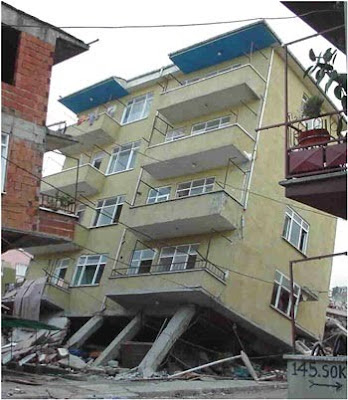
Unsafe!: "Soft first story" is a building with parking or shops below apartments

4. Prepare two emergency response kits - one for your home and family, the other for your car in case you are far from home when it strikes. If I am in Berkeley at the time of a major earthquake I would need good walking shoes, small bills for buying necessities, and portable food for my long walk home! http://www.ehow.com/how_4536778_make-earthquake-kit-car.html

5. I keep a bookmark on my computer on this site from the Geological Survey - it shows instant results immediately after each earthquake to show how strong it was and where it was located - also interesting to see how many small quakes we have each day.

http://earthquake.usgs.gov/earthquakes/recenteqsus/Maps/special/California_Nevada.php