Pages

Friday, February 26, 2016

Green jeeps and mosquitos

All this business with the Zika virus reminds me of the summer jobs I had starting with the summer after my sophomore year  until I completed the local community college. I worked for the Delta Mosquito Abatement, located in the north end of Visalia California in the Central Valley. At the operation center there was a metal Quonset Hut for the "bosses", a parking area for a fleet of old Korean war surplus jeeps (each outfitted with a 200-gallon tank filled with Parathion insect spray), and a garage overseen by a tough old guy names "Buster" - he took great care of the jeeps, and all the equipment - and tried his best to put the fear into us to not do anything stupid that would harm 'his' equipment. 
My Jeep was never so clean - At times I would return to my Jeep and find cows gathered around sticking their heads inside...
A 4 gallon Hudson sprayer - these babies were heavy then carried through thick mud on a hot day!
Each summer morning at 7 AM the drivers and helpers gathered out in the open air near the gas pump for the daily briefing - and special information that was pertinent to us all - any new mosquito information, any 'civilian' complaints, anything 'to do' or 'not to do'.The field operators could also put in orders for certain large fields to be sprayed from the air. We had an old slow stable Stierman biwing with a very 'colorful' pilot - who loved what he did...


San Joaquin  - with irrigation it is green and wonderful - no water - it turns dry and dusty
When I began, I was a "helper", and  every morning I climbed into the Jeep with Matt D. (the field operator in charge of the area we worked) ... an interesting guy... Native to Oklahoma, his family came west with the dust bowl, he was drafted into the Army - went to fight in the Pacific islands.   He still bore the emotional scars from the experience. He was a wealth of amazing stories about his life and adventures.  He loved old time country music. Little Jimmy Dickens, Earl Tubbs, Hank Williams...And from him I learned to "talk Oakie".
The Jeep had no doors or walls and in the early summer air it was  really cold- We drove north to Goshen Junction and then east toward the area of New London California - the land was flat and only produced  crops because  of irrigation water. And that was the problem - there were constantly large areas of land with standing water.  


Dipper method - looking for larva
Matt had to keep meticulous data of each of the many fields for which he was responsible.  We would at times take water dippers and collect a sample of water to look for larva.  Alfalfa and pasture lands most often had a species called: 'Aedes nigromaculis'. This one is a serious pest and can be very prolific.  We also looked in standing tubs, flower pots, horse tanks for 'Culex tarsalis' - this one is capable of carrying encephalitis.  One that we dreaded to find were the "Anopheles" mosquitos capable of spreading malaria.

Note abdomen filled with blood
When we identified an alfalfa field with active larva - we got out of our jeep - filled 4-gallon pressure cans with Parathion spray, pumped them up by hand,  then I slung the can onto my back with the strap crossing my chest and off we went.  The two of us would walk the  field swinging out wands back and forth releasing spray.  Sometimes we would start on opposite sides and work to the middle.  Many fields were deep with sticky mud.  
The only photo I could find - and old WW II photo - but we did it the same way ( except this tank has a different pressurizing system)
 There were often clouds of mosquitos to content with. A big field might take much of a morning or afternoon.  Sometimes when Matt had extra work I would drop me alone to spray a field alone.  In those cases, he sat up a 50-gallon tank on sawhorses so that I could refill my can.  When lunch time came around we often drove in to Traver California - there was a grocery store, a China Berry tree and a tiny patch of lawn where we ate lunch. 

When we were in the neighborhood at break time we would go to a truck stop for coffee and a donut
My favorite General store in  Traver California - good place to by Moon pies and Coke
All the little towns in this area were inhabited by seasonal field workers.  The towns would generally be considered as centers of rural poverty. The homes are made of simple materials, often no paint, have weed filled yards, skinny barking dogs. But the people that we met often had fascinating life stories to tell.  One particular wino often came to eat with us (he mostly was happy to share our lunches).  Sometimes he had items that he had stolen that he tried to sell to us...But he was a jolly man with stories about jail, his lost loves, some big 'deal' coming up...
 
The style of homes in New London and Traver... I hope that  conditions there have improved
Make of the people in these towns were descendants of those who escaped the dust bowl in the midwest
Finally, the day came that I got my own little green jeep - I was promoted to spraying dairy drains!  The work was much easier but I missed the camaraderie of working with Matt.  Milking requires a lot of water-  and vast amounts of water collect and breed mosquitos.  Many dairies had made long trench drainage areas -about 12 ft., wide and the length depended on the size of the dairy, the trench was dug to be about 12 feet deep.  Some just let the water go where it will. On a typical day I drove about 100 miles - Going from one dairy to the next.  
The life cycle was dependent on the day and night temperatures
Many of them I could spray without leaving the jeep - I just drove slowly by the pit or pond of drainage area and sprayed my poison onto the surface.  Some were not jeep accessible and then I was to walk into the farm or along one of the the sloughs.  I learned to deal with savage farm dogs!  My favorite slough was one that was about chest deep and there were thick blackberry vines on each side - so I had to walk down the middle of the slough, spraying as I went,  through slimy mud and floating duckweed... but I loved the biology of this place.  I needed two full days to complete all of the dairy drains on my route.  Many of the dairies were owned by Portuguese dairymen - who frequently went out of their way to offer me fruit from their trees. Thats where I learned to love fresh ripe figs!
Delta Mosquito abatement also had a person who went around putting mosquito fish into home ponds, horse tanks, or other  permanent water
A memorable day I recall was the day that 2 of us were sent out to deal with a mosquito source- it happened to be by a watermelon field.  The owner was still there and we asked if we could pick over the left over melons (and there were a lot of them) - he said "Sure - take all you want - I'm going to plow this up” So we loaded the jeep with watermelons - full and over full with watermelons.  Wouldn’t you know it - some well intentioned citizen phoned in to the office and said that 2 "mosquito boys" had stolen a bunch of melons.  Fortunately, it was Buster who took the call - and when we drove in the gate - there was Buster in his best Staff Sergeant pose asking us to explain ourselves - we did - gave a nice melon to Buster and it all ended well.
That's me - here I am spraying herbicide around d a dairy drain so that the poison can reach the water - this is a special jeep just for that...


When I think about those years - I remember barb wire fences,fields full of cows ( and occasionally bulls), vast dust devils swirling on a hot summer day, heat and dust, mud, deep mud, and hoards of mosquitos... but I remember faces and voices - so many good people...

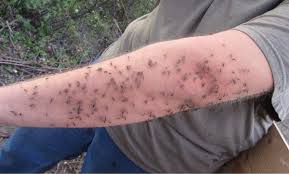
What my arm looked like on many occasions - It was often so hot that I didn't want long sleeves unless I needed them.


Friday, February 19, 2016

..."And that's the way it was!"

Images this week are from Google Images - and show examples of the "Oral Tradition"

I grew up among people who appreciated good story telling!   Telling stories was partly entertainment and partly about building relationship.  I  was born into a world where extended family and friends  gathered on Sunday afternoons - and I remember circles of people sitting in small farm house dining rooms or parlors  talking together.  As the conversation progressed - someone would say - "That reminds me of a story.." ...and off we would go... Everyone listens and remembers, chuckles and agrees...  and that often leads to another story.  Good storytellers were prized - and since many of the stories had  been heard before - the telling of the story was important  - the timing - the emphasis - the accurate recall of details...

This could be me listening to my Uncle John ( except he talked about mountains and dessert - not the ocean ) 

This  is what modern anthropologists would call an oral tradition of telling stories about the past to remind people of who they are.  Some stories were funny , and some  sad, some about overcoming hardships, and some about getting out of scrapes, some personal, some about people long gone.  This last weekend I was talking to a cousin who was telling me again some of his stories ... hearing stories is a powerful way of connecting with people present and past...

Why is out so good to hear someone tell you the stories from their life or history?

One of my favorite family story tellers was one of my uncles - As he got older I told him "Uncle John - I wish you would write your stories down" - and after much encouragement to everybody surprise - he sold his prized hunting rifle and bought a used typewriter - and he began writing  story after story - I told him that I would duplicate and distribute to the family all of his writing - It ended up with over 300 pages of double spaced typing.  I realize that I was urging  him to break the oral tradition - but now I am glad  now to have his stories recorded in print.

Good story telling is different from gossip - The oral history that I knew never made fun of or diminished another person 


Here are two of Uncle John's  stories

"After the war, one day I was walking near the family farm and I saw a sign saying that the next weekend a  pilot would be landing in this cow pasture and would take people up for $5.00.  I had never flown before so it sounded like a good deal - even though he was charging a big price.   When I got there Saturday morning I saw the plane sitting there - it was an old bi-wing plane with  fabric covered wings and two open-air seats - the pilot in front. To get in you had to climb over the side, and once you were seated not much over the head was visible from the outside. 


All cultures - all peoples-  taught with oral history before there were schools


So I got in and fastened the safety belt and the pilot got in the front - and he called on his mechanic to start the motor.   The mechanic took hold of the propeller and the pilot called out 'contact; turned on the ignition switch, and the mechanic gave the propeller a pull ... it started OK and we taxied to the end of the cow field  and turned to face the wind - then the motor stalled ... the pilot climbed out of the cockpit and proceeded to restart the motor  by himself.  The plane immediately started forward  -
The pilot made a dash for the end of the wing to grab hold- but he lost his footing and fell down - and by the time he got up the plane was moving too fast for him to catch it...

Jesus taught by speaking to his followers in the oral tradition

So here I was a passenger in a plane with no pilot racing down the cow pasture...  I first thought to bail out - but the ground by then was moving fast and if I jumped I might break my neck. 
Then I remembered that every gasoline engine has an ignition switch so I climbed into the pilots cockpit and started looking for something that looked like an ignition switch - a rather large toggle switch caught my eye and when I flipped it - the motor came to a sudden stop... it kept rolling forward and stopped a few feet before it would have hit a truck full of airplane gasoline... The pilot came running up and thanked me for stopping the plane and gave me my 5$ back. ... and then took me on a good long ride showing me all the local sights from the air..."

Campfires and story telling - they seem to go together


And a second example:

My brother Frank and a friend George were hunting for Rocky Mountain Goats.  It was late in the season and snow was already thick at high elevations.  They had brought skis along so that we could follow the goats if they moved above the snow line.  They made camp on a little flat place on the rugged granite mountain side - The slopes were very steep ...  In the morning it the sky was  clear and it was very cold.   Frank and George started up the slopes with skis and rifles.  They had no luck seeing goats. After lunch they circled back over the north slope - they crossed the snow field on skis - Frank was a little lower than George-  - he got about half way across and the snow began to move until his skis and quickly gathered speed and volume as it crashed down the mountainside.  When  things settled down,  George went down as fast as he could to where the avalanche stopped and found Frank trapped in the snow - His head was sticking out but her was locked in tight with the snow. he was more or less upright but  his feel were still attached to the skis, and they were were buried deep in the snow.   So George set about digging him out with his hands until Frank could help get free...

Uncle John as a young man on the sides of the Snake River in Idaho - creating good experiences to tell about...


Once they got him out, they took stock of Frank's condition and found only bruises and some sore muscles from the twisting he had done - but  he was otherwise unhurt.  Even his rifle that he carried by a shoulder  strap was still with him... I guess his guardian angle was with him all the way that day!  Frank didn’t feel much like going out the next day - but a day later they were back on the slopes and each of them came home with a nice trophy sized Billy.

Now... sometimes I have trouble relating with some of the stories from my conservationist perspective today - but I still like getting in touch with there view of things a few decades back...  I do think that growing up with such stories gave me a sense that having adventures was good and the importance of being resourceful no matter what... They gave me permission...